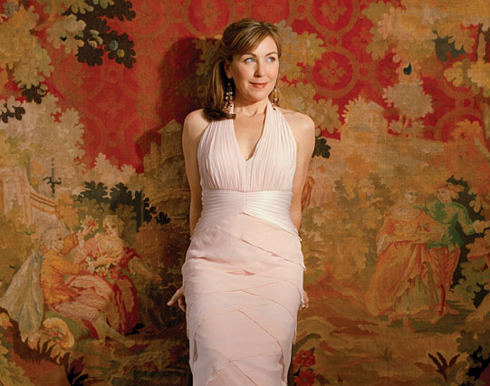
The highlight of Saturday’s all-Shakespeare-inspired “Food of Love” concert by the Oregon Mozart Players was, without a doubt, soprano Mary Dunleavy’s heart-rending performance of two arias — “Willow Song” and “Ave Maria” — from Act IV of Verdi’s opera Otello.
Dunleavy, who has appeared with all the great opera companies here in the United States and with many around the world, didn’t just sing the role of Desdemona, the young beauty falsely accused of infidelity by her older husband, Otello. She was Desdemona, lamenting her own undeserved death as she prepared for bed, talked to her maid, and prayed.
I had the opportunity to meet Dunleavy on Friday morning and talk with her about singing the Queen of the Night more than 80 times, the world of opera in general, and her 7-year-old daughter, Madeleine.
She first met OMP music director Kelly Kuo — they’re on the faculty together at the University of Texas at Austin — doing a production of La Traviata in Beijing. “It was totally bizarre,” she said. “They have a totally different way of doing things. The audience needed some instruction — they don’t like to sit and be polite and quiet.”
Dunleavy grew up in New Jersey in an Irish-American household with plenty of music. Her father, she said, is a “beautiful high Irish baritone — and still pretty good at 86.” Going to Broadway musicals was a high point of her childhood, and when Dunleavy was 12, she was cast as the lead in a school production of Annie. A teacher told her parents to get her voice lessons. They did.
She recalls listening to Carmen in a four-record set and thinking, “Where has this been all my life?”
Then her mother took her to see Rigoletto at the Metropolitan Opera and she saw opera live for the first time. The tenor’s voice cracked. That amazed her. “That’s the vulnerability and frailty of opera,” she said.
Dunleavy laughed when I brought up the demanding coloratura role of the Queen of the Night in Mozart’s The Magic Flute. By one count, she performed it 84 times between 1994 and 2002. She’s glad for it to be in her past.
“It seems such a long time ago,” she said. “When I hear the music, I still get a reaction. There are a lot of white-knuckle moments. My blood pressure goes up when I hear it. I have to remind myself I’m not singing it.”
Her favorite role? Perhaps Violetta, in Traviata. “I have done Violetta so many times. And I never get tired of it. It’s a great story, and she’s a great character, so beautifully written.”
Immersing herself in the deep emotion of opera has its hazards. Two years ago, Dunleavy sang the lead role of Cio-Cio-san in a production of Madame Butterfly with Chautauqua Opera. Her daughter, then 5, was cast as Dolore, her son, who witnesses Butterfly’s death at the end of the story. “I knew she was going to be fantastic,” Dunleavy said. “I knew I could trust her. And I knew she was somebody I could pick up.”
But watching her mother die, even theatrically, in rehearsal after rehearsal was trying for Madeleine. “I always worry about me crying,” Dunleavy said. “And this was hard on her. In rehearsal her head was against my chest and I could feel her whole body shaking. So I said to her, ‘No matter what happens — if you cry or don’t cry — we have to keep going.'”
In the final dress rehearsal Madeleine held it together. And then, in performance, the tears came again — but she kept going. “It’s a very special memory,” Dunleavy said.
The rest of Saturday’s Shakespeare program included music from Mendelssohn’s “A Midsummer Night’s Dream” and, more remarkably, Shostakovich’s “Hamlet” suite. The latter program included an actor from the University of Oregon theater department, Karsten Topelmann, who offered brief lines from the play between the 15 short musical movements while dressed in a twin-gender Elizabethan costume, male on one side and female on the other.
This was one time it would have paid to read the program notes before the music started. I didn’t, until I found myself wondering what on earth was going on, and squinted at my program in the darkness. Shostakovich’s “Hamlet,” it seems, was written for a 1932 avant-garde production in Moscow that posited a fat, ugly Hamlet, with Ophelia as a tart and a weak, likeable Claudius. Topelmann, as directed by John Schmor, performed almost deadpan, and so missed entirely the burlesque and buffoonery — if you closed your eyes, you could almost see beach balls bouncing around the stage — that Shostakovich’s music captured so well.