Eugene Art Talk

Bob Keefer on art and music around Eugene, Oregon

Search results: "mayor's" (page 2 of 2)

Closing the Jacobs Gallery will be an “emergency” for Eugene, says physician and sculptor Roger Hall

Roger Hall in his sculpture studio.

Eugene radiologist Roger Hall, about whom I’ve written before, called the announced closing of the non-profit Jacobs Gallery an “emergency” in testimony before the Eugene City Council last week.

The Jacobs, which is to close in January, until recently enjoyed a direct city subsidy that had kept it in operation for the past couple decades. The gallery is housed in the city-owned Hult Center for the Performing Arts.

A former Lane Community College board member, Hall is also an accomplished metal sculptor - and had been scheduled for his own Jacobs exhibition in 2016.

Here are his remarks to the city council:

My name is Roger Hall.

I was an elected member of the Lane Community College board of education for twenty years.

I have been in your shoes.

I know what it is like to approve a budget and allocate funds throughout a complex organization. I also know that there are contingency funds to be used in budgetary emergencies.

We have such an emergency now. It’s called the Hult Center and the Jacobs Gallery.

I am not here to sell you on art. I am here to sell you on the integrity of the Hult Center, which served roughly 140,000 people last year and is a cultural hub of Eugene. The Jacobs Gallery is an integral part of that center, the site of the Mayor’s Art Show and an important venue of visual art.

Let me quote our city website: “The city of Eugene is rich in arts and culture… the renowned Jacobs Gallery displays curated visual art exhibits that bring patrons and visitors to the center during the day and prior to performances….”

Last year the gallery had 10,500 visitors and sold thousands of dollars of art. Let me say it again, 10,500 visitors! And we are going to let it close?

For $150,000, a minute percentage of the city’s budget and less than 2 percent of the more than $6 million designated for culture and art, we could fund the Jacobs Gallery.

The gallery, which had minimal (city) support this year, has been administered by a dedicated director, Beverly Soasey, and a volunteer board. Once closed, the gallery will not easily be re-opened. To find a director such as Beverly and a new board with the same talent and dedication would be almost impossible.

I have been on boards that have had the wisdom and courage to modify previous unwise decisions. I am hopeful that you will rethink this issue and have the wisdom and courage to do what is right for the city of Eugene by protecting the integrity of the Hult Center and funding the Jacobs Gallery.


Tonight’s Art Walk went sky high, with a drone

BK3_5323

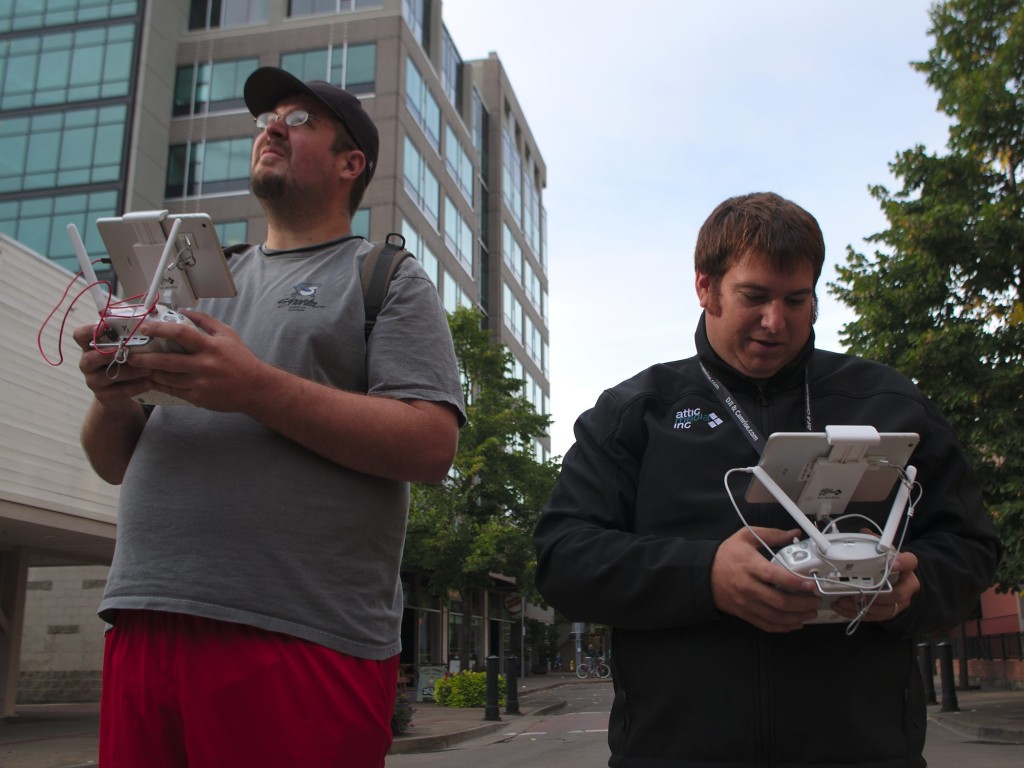
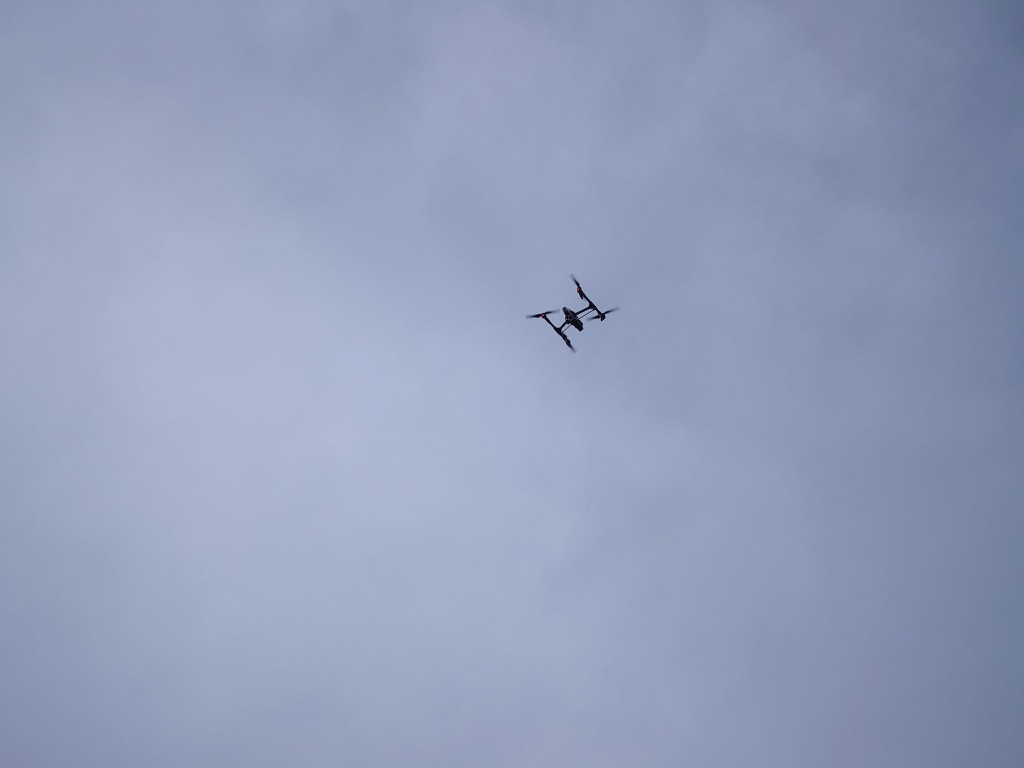
These days you know you’re at a trendy event when there’s a drone involved. I looked up at the beginning of Friday’s First Friday Art Walk downtown and saw, for the first time in my life, a small drone, in the wild. It was creating a buzz overhead at the corner of Broadway and Willamette Street.

BK3_5319

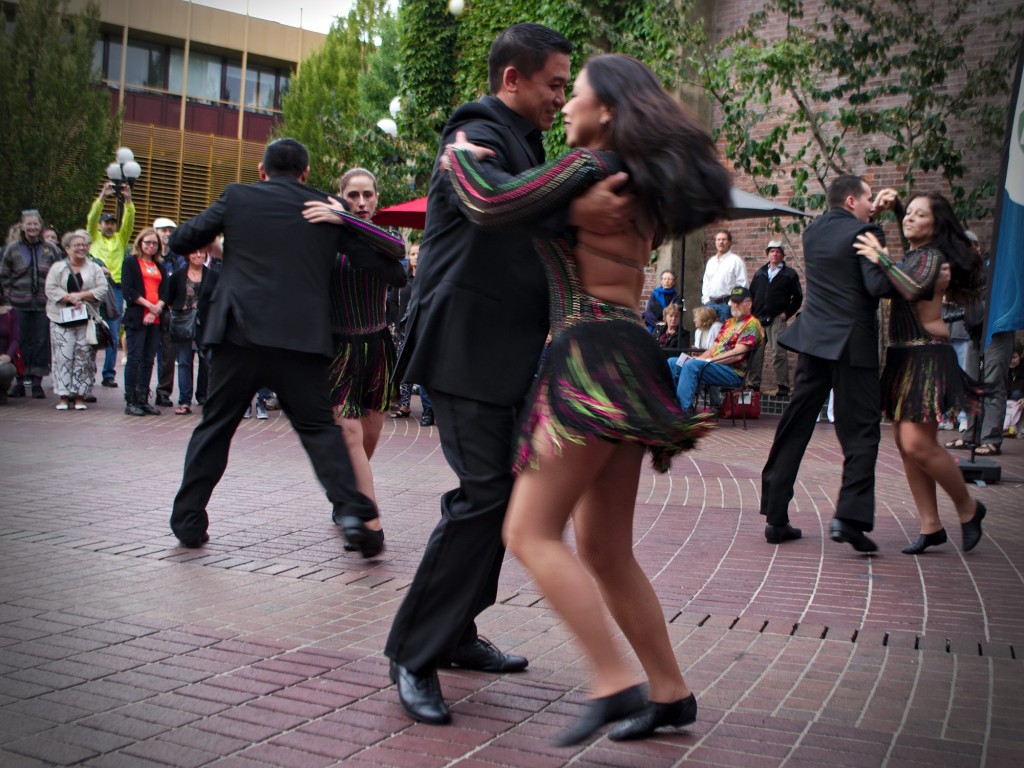
Half a block away I ran Attic Media‘s Ryan Postma, at right in the photo at top. He and his pilot were having a great time flying over the crowd that had assembled to see live dancers at Kesey Square.
BK3_5295

It was a great First Friday — lots of people despite the threat of rain. The biggest crowd I saw was at the Jacobs Gallery, to check out the Mayor’s Art Show.

BK3_5346

BK3_5289


Eugene’s Macchia Six bring beautiful fresh landscapes to the Jacobs Gallery

BK3_3775

Not many artists these days endeavor to start their own artistic school. Eugene painter Jerry Ross, though, has just enough romantic flair in his soul to set himself up as the head of a movement that could have grown out of 19th century Italy.

Don’t believe me? Check Wikipedia, which gives a history of American Verismo that includes the work of Ross and his students at Maude Kerns Art Center. You can even find a Manifesto of American Verismo on Ross’ website.

Basically, we’re talking a loose, impressionistic style of plein air painting that actually did originate in Italy a few years before the more famous French impressionists took up the practice. Ross, a confirmed Italophile and long-time art activist — he founded the now defunct Salon des Refuses years ago in response to the Mayor’s Art Show — has been practicing and teaching this style of painting for years. And he does know what he’s doing with a paint brush.

So do at least five of his students — Victoria Biedron, Jean Denis, Jaqueline Hamer Lukowski, Patti McNutt and Sally Schwader.

The work of this Macchia Six — Ross has always managed a slight political edge to his art, as with this title — makes a delicious landscape show that’s on exhibit at the Jacobs Gallery, in the bottom level of the Hult Center downtown, through May 2.

It’s a quiet, thoughtful show, one that’s easy to like. And with six participating artists, it has a lot of paintings; many are hung salon style, one above another on the gallery walls.

The paintings here — of trees, mountains, roads and sky — are enough alike in construction and sensibility that, at least at a casual glance, I probably couldn’t tell one painter in the show from another without the wall cards identifying the artists.

Their palettes are similar, if not entirely the same, woven from earth tones with a few hints of warm purple. The paint surface is pretty uniformly thin and matte. Strokes are bold. “Macchia” turns out to mean “stain,” referring to the loose construction of this style of work, starting with blotches.

Willamette Rhapsody

Willamette Rhapsody

Ross is not a painter I’d ever accuse of being commercial, but working in this kind of impressionist style, with an Italian flavor thrown in, might be just right for the local market, and I hope the show sells a lot. The images are local, but have a slightly exotic tinge, offering a richer version of the California impressionism that’s been so popular for so long in the West.

Two of my favorites are Patti McNutt’s Willamette Rhapsody, which perfectly captures a quiet stretch of water and surrounding trees, and Victoria Biedron’s View From a Train — the title could belong to a novel — which alone in this show full of nature offers a glimpse of industrial darkness surrounding railroad track.


Jacobs Gallery shrinking with city budget cuts

The Jacobs Gallery has a new sign, but a smaller floor plan.

The Jacobs Gallery, which is the closest thing Eugene has to a municipal art gallery, is shrinking.

As the 2014 Mayor’s Art Show was being taken down this week, room for two offices — one each for the gallery executive director, Holly Monnette, and artistic director, Beverly Soasey — were being carved out of the small gallery, which sits on the lower level of the Hult Center.

Monnette said today the offices will eat up a rectangle about 9.5 by 16 feet from the gallery floor, which measure about 35 feet by 35 feet in all. They’ll be located on the immediate right as you walk in from the outside door, about where the docent’s table has sat in the past.

Monnette was circumspect about the development. “Being in the Hult Center is a gift,” she said. “We have no claim on the space.”

The Jacobs, an independent non-profit, pays no rent or utilities for using the space. In the past, the gallery had also received an annual subsidy of as much as $30,000 a year from the city. That payment, though, was cut to $15,000 last summer and will go away completely next year, Monnette said,

The new offices were needed because of consolidation of space by the city’s Cultural Services Division. “Our old space is going to be taken by the ushers,” she said. The new gallery offices will be cubicles, meaning that gallery goers will be able to easily hear discussions or telephone calls made by the two staffers as they work.

The move should be completed by the end of October, she added.

Eugene artist Fran Ross learned of the change when she went to pick up her art work from the Mayor’s Art Show, which just closed.

She was shocked at what she found and said the city’s art priorities are skewed. “You go to the Cultural Services website and they are all proud of the electrical boxes that have been painted around town,” she said. “Really? Who goes to a city because it painted its electrical boxes?”


Eugene artist Tallmadge Doyle picks up new artistic pieces in “After the Storm” at Schrager & Clarke Gallery

Tallmadge Doyle: Cascade III

In the aftermath of last winter’s howling ice storm, which leveled trees and plants across the county, Eugene artist Tallmadge Doyle was out in her yard collecting branches.

Doyle, a career printmaker, brought a handful of sticks and leaves into her home studio and was pinning them up to a wall so she could draw them when she caught the captivating shadow they made on the wall’s white surface.

“I just started hauling all this stuff in. I really, really liked the contrast of the silhouettes — and then that delicate line with the strong silhouette over it,” she said during a visit to her studio last week, pointing to a fine line in one image that swirls gracefully through the composition. “The line is a real loose interpretation of the same forms I use in the silhouette.”

The prints — and other images — she’s made from that experience are the basis of a new show of her work — the first in some years — that opens next week at the Schrager & Clarke Gallery downtown.

Doyle: Turning Poison into Medicine

Called “Tally” by friends and family, Doyle has been known for her strong scientific bent as an artist. She’s combined imagery from animals and plants with symbols from ancient scientific texts in her work, which is often finely crafted to the point of obsession.

You can see some of her previous work at the University of Oregon’s Ford Alumni Center, whose ground-floor fireplace lounge sports not prints by Doyle but original copper plates from a series of images she did of Northwest animals.

You can see a small print from her current series of silhouettes in the Mayor’s Art Show, which runs through Oct. 4 at the Jacobs Gallery downtown.

As we talked last week, Doyle pointed out an engaging image she recently made of a Eurasian eagle owl that’s in captivity at Cascades Raptor Center in Eugene; she created the image from life drawings and photographs of the bird.

“That was an extremely labor-intensive project,” she laughed. “I worked on that piece off and on for a year.”

But the new work is different. The strong, graphic silhouettes give it a slightly archaic feel, like a 19th century portrait silhouette in a cameo. Doyle is exploiting this aspect further in a series of mixed media images she’s made — not prints, but painted directly on wood panels — that are cut in an elliptical shape.

But the prints themselves are the strongest, combining the stark shadows with Doyle’s finely intriguing line work.

The new show opens Wednesday at Schrager & Clarke and will have a reception during the First Friday ArtWalk. It’s the first solo exhibition of Doyle’s work locally in years. Her last gallery show was two years ago at the Davidson Gallery in Seattle.

The exhibit will also include small oil on panel paintings she did at the Sitka Center for Art and Ecology on the Oregon coast.


After the Storm
Prints and drawings by Eugene artist Tallmadge Doyle

Schrager & Clarke Gallery, 760 Willamette St., Eugene
October 1 through November 8, 2014
Reception during the First Friday ArtWalk, 5:30 p.m. to 8:00 p.m. October 3
Artist Talk at 4 p.m. Saturday, October 25
More information: 541-731-8815

Newer posts »

© 2016 Eugene Art Talk

Theme by Anders Noren — Up ↑